First Sanctuary of Pooplicism · Springfield, Illinois · Now Open — As Always
Springfield, Illinois · Consecrated in Perpetuity
THE POOP TREE
The most holy site in the capital city, and the beating heart of the faith called Pooplicism — a single tree, a wooden sign, and a promise kept every hour of every day since the beginning.
By bradleyrayhaptonstall · 3:49 · A Bluegrass Ballad Hymn
Every sanctuary, given time, receives a hymn. Ours arrived as a bluegrass ballad — three minutes and forty-nine seconds on the Tree, its Sign, and the promise that has never once been broken. It is sung here by leave of its maker, through the official Suno player, and it belongs now to every pilgrim who stands in the shade. The Tree is open. It always is — and now it sings.
The hymn tries to sing the moment this page opens. If your browser holds it back — as browsers do — the first tap or click anywhere on the page sets it free.
The hymn rests. Press play, and the Tree sings again.
This is the sanctuary's home. Every teaching, vision, and rite of Pooplicism now keeps its own page — choose a door below, or use the menu above. Whichever you choose, you will find the Tree exactly as you left it: open.
Other sanctuaries keep hours. The Poop Tree keeps a covenant. Through blizzard and blackout, holiday and heatwave, the canopy stands open — because a tree does not lock its doors, and neither does grace.
—
Days Open
—
Hours
—
Minutes
—
Seconds
Continuously open since the Consecration — counted live, above, without a single pause.
Monday
Open 24 Hours
Tuesday
Open 24 Hours
Wednesday
Open 24 Hours
Thursday
Open 24 Hours
Friday
Open 24 Hours
Saturday
Open 24 Hours
Sunday
Open 24 Hours
Holidays, Leap Days & Days Yet Unnamed
Open 24 Hours
Last closed: never. Next scheduled closure: none, in this age or any other.
Every cathedral begins with a stone. Ours began with a seed, a roadside, and an act of devotion so humble that heaven itself took notice.
In the beginning there was a parking lot, and it was without shade, and the asphalt was hot upon the feet of all who crossed it. And the travelers of Springfield cried out — not in words, for who cries out in a parking lot — but in the quiet, universal language of those who have eaten well and now require a place of dignity and relief.
Then, from a source the chroniclers describe only as an offering, perfectly placed, a seed was deposited at the edge of the lot, in soil enriched beyond all agricultural reason. Where ordinary seeds hesitate, this one did not. It rose with a speed that local gardeners still describe as "frankly unsettling," and within a single generation of seasons it stood in full crimson glory over the intersection — the most magnificent tree in Sangamon County, fed by the humblest of beginnings.
The people understood at once. Here was the whole of theology in a single organism: that nothing is too lowly to be lifted up, that what the world discards, the earth redeems, and that glory, given time and sunlight, smells surprisingly like autumn leaves.
"From the lowest place it rose, and to the lowest it still bends its shade. Therefore let no pilgrim be turned away, at any hour, on any day, forever."
— From the Sign, which is Scripture enough
In time, the faithful erected the Sign — two posts, one board, lettering of gold upon deep green — and upon it they carved the only doctrine the Tree has ever required: its name, and its hours. 24 hours a day, 7 days a week. Not a boast. A vow. The Tree has kept it every second since, and the counting clock in the sanctuary above has never once been reset, because there has never been an occasion to reset it.
Scholars from as far away as Jacksonville have studied the Tree and departed baffled, then returned quietly, alone, at 3 a.m. — when the sanctuary, like the Tree, receives all comers without question. This is known among the keepers as the Hour of the Humbled, and it is the holiest hour of all.
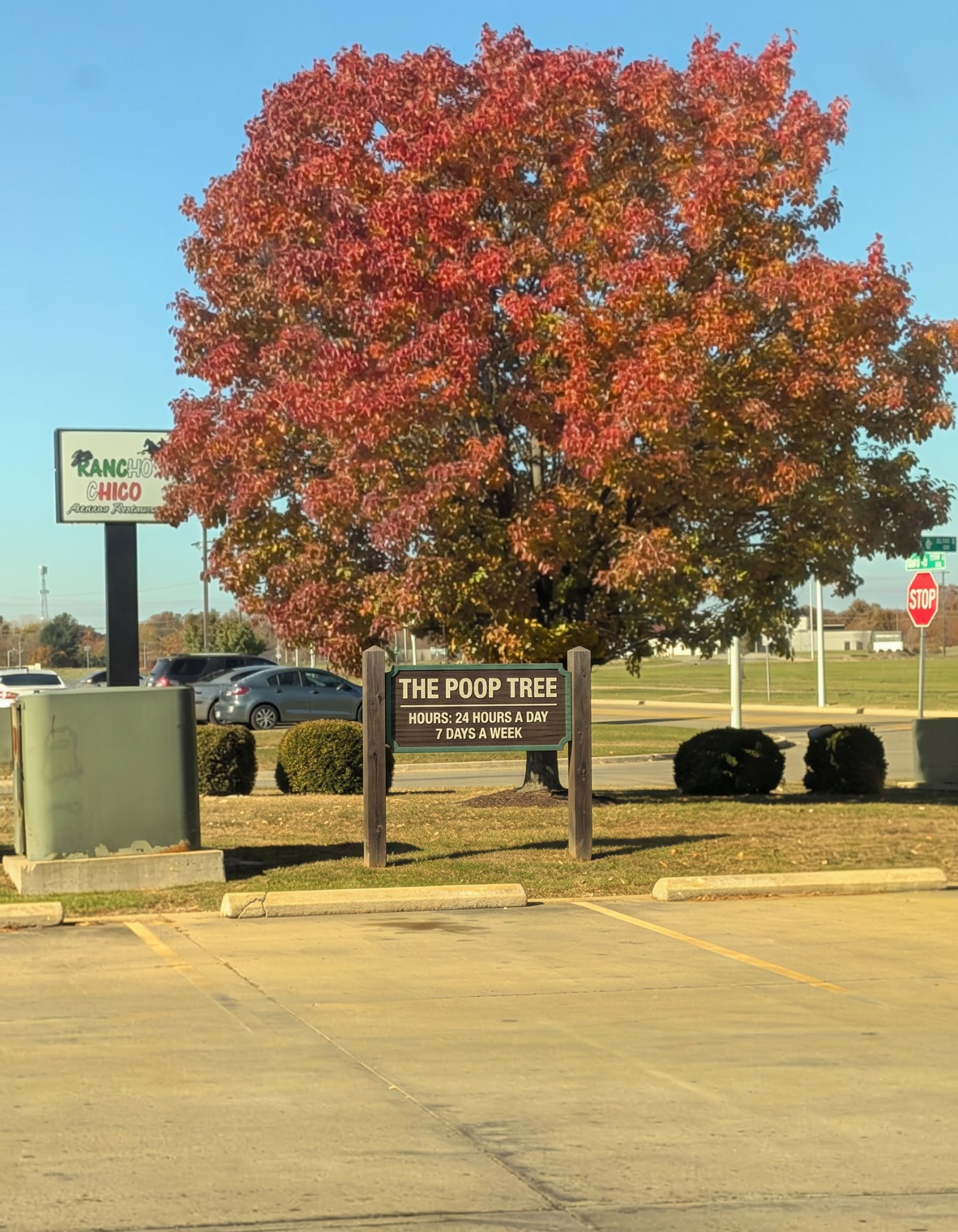
The Tree as it stands today, photographed by a pilgrim in the fullness of autumn. No filter. None required.
The Annals
The Ages of the Tree
The Time Before
The Lot Lies Fallow
An ordinary roadside in Springfield. Cars, commerce, a fine Mexican restaurant. Nothing holy whatsoever. The earth waited, patient as ever.
The Offering
The Seed Is Deposited
An anonymous benefactor — identity unknown to this day, known only to the Tree — makes the founding contribution. The chroniclers record no name, for the greatest gifts are given in secret.
The Rising
The Crimson Miracle
The sapling erupts into a canopy of impossible red. Motorists slow down. Some stop entirely. The first pilgrim is recorded as "a guy who just stood there for a while." He has never been identified. He is all of us.
The Consecration
The Sign Is Raised
Two posts. One board. Gold letters on green: THE POOP TREE — HOURS: 24 HOURS A DAY, 7 DAYS A WEEK. With those words the site is consecrated and the Eternal Schedule begins. It has not been interrupted since.
The Present Age
The Pilgrims Multiply
Word spreads the way all true things spread: person to person, usually while laughing, then going quiet. The faith takes its name — Pooplicism — and its followers theirs: the Pooplicists. The Tree now receives the faithful at every hour, in every season, in every condition of soul.
Every holy place eventually gathers a faith around it, the way the Tree gathers light. The faith of The Poop Tree is called Pooplicism, and its followers — by now beyond counting, though the Tree has never once asked for a census — are the Pooplicists.
Pooplicism is, by the admission of its own adherents, the least demanding religion ever to flourish. It has no scripture but the Sign — and, in time, the Book that gathers the Sign's story — no clergy but the keepers who sweep the lot, no temple but the canopy, and no hell whatsoever — the Pooplicists considered the concept and voted it down, unanimously, on the grounds that the Tree would never permit it.
There is no conversion in Pooplicism, for there is nothing to convert from. One does not join the faith. One simply notices — usually mid-laugh, standing in a parking lot in Springfield as the light comes through the red leaves — that one has believed for quite some time. That moment of noticing is the entire ceremony. Pooplicists call it the Recognition, and it has been observed at every hour of the day and night, because the sanctuary, like the faith, observes no closing time.
The Pooplicists are a notably cheerful people. They hold that dignity is not bestowed but grown; that the lowliest beginning is no prophecy of the end; and that a promise plainly stated and eternally kept — 24 hours a day, 7 days a week — is worth more than all the marble in Europe. They greet one another with the words of the Sign, and they part with the faith's oldest blessing: "The Tree is open." To which the only correct reply is: "It always is."
The Pooplicist's Profession
I believe in the Tree, which rose from the lowest place and asks nothing of me but that I stand in its shade honestly.
I believe in the Sign, which says what it is in gold letters and has never once lied about the hours.
I believe in the Turning — crimson, bare, budding, green — and that I, too, am holy in every season I pass through.
I believe the door that does not exist can never be shut against me.
For generations the Pooplicists said the Sign was scripture enough — and it is. But the keepers grew tired of watching pilgrims drive away with the whole faith memorized and the whole story untold, so they gathered the story here: the Creation, the Commandments, the Parables of the Parking Lot, and the Blessings, exactly as they are spoken beneath the canopy.
❧
Herein Is Contained
THE BOOK OF THE POOP TREE
Being a true and complete account of the Tree that rose from the lowest place, kept the longest hours, and turned no one away — set down by the Keepers of the Sign at Springfield, Illinois, for pilgrims of every hour.
1In the beginning there was a parking lot, and the lot was without shade, and the asphalt was hot upon the feet of all who crossed it. 2And beside the lot there stood a restaurant of good report, and the people ate well there, and went forth full — and in their fullness, they required a place of dignity. 3And the earth heard them, though they spoke not a word, for the earth is fluent in such matters.
4Then came the Offering, which the Book does not describe and the keepers do not explain, save to say that it was perfectly placed and given in secret by a benefactor whose name is known only to the Tree. 5And in the Offering there was a seed. 6And the soil that received it was enriched beyond all agricultural reason, and the seed — where ordinary seeds hesitate — did not hesitate.
7Let the learned dispute the manner of it. The Book records only the result, which no one disputes, because it is still standing there: from the lowest place, the highest glory in Sangamon County. This is the first teaching, and all the others are commentary: nothing is too lowly to be lifted up, and no beginning is a prophecy of the end.
Chapter the Second
The Rising & the Raising of the Sign
1And the seed rose with a speed the gardeners of the county still call frankly unsettling, and in the fullness of autumn it stood in crimson glory over the road, and motorists slowed, and some stopped entirely, and did not know why. 2And the first pilgrim came — a man whose name the Book does not record, for he is all of us — and he stood beneath the canopy for a while, and said nothing, and left changed in a way he could not have itemized.
3Then the faithful raised the Sign: two posts, one board, gold letters upon deep green. And upon it they wrote the whole of the law in two lines — the Name, and the Hours: 24 hours a day, 7 days a week.4Not a boast. A vow. 5And the Tree has kept that vow every second since, in blizzard and blackout and heatwave, for a tree does not lock its doors, and neither does grace.
"From the lowest place it rose, and to the lowest it still bends its shade. Therefore let no pilgrim be turned away, at any hour, on any day, forever."
— The Decree of the Sign
Chapter the Third
The Commandments of the Canopy
Given beneath the Tree, to be kept at every hour — for the sanctuary in which they were given has no other kind.
I
Thou shalt turn no pilgrim away — not for the hour of their coming, nor the state of their soul, nor the manner of their arrival. If they have arrived, they were expected.
II
Thou shalt judge nothing by its beginning. The lowest place is a place, not a verdict. What the world calls waste, the earth calls beginning.
III
Thou shalt give shade without question, and ask for no account of any who rest in it. Rest first. Reflect later. This order is not negotiable.
IV
Thou shalt speak plainly, in gold letters, and keep the hours thou promisest. Say what thou art. Be open when thou saidst thou wouldst be open.
V
Thou shalt honor every season thou passest through — crimson, bare, budding, and green alike — in thyself as in the Tree, for all of them are holy and none of them is the last.
VI
Thou shalt laugh, and let no one shame thy laughter at the holy place, for laughter is a form of prayer and the first sound every pilgrim makes.
VII
Thou shalt leave the lot better than thou foundest it, and carry the welcome with thee when thou goest — forever unifying, forever undecaying, with love, liberty, and acceptance for all.
Chapter the Fourth
The Parables of the Parking Lot
The First Parable
The Man Who Came at 3 A.M.
A man came to the Tree in the third hour of the night, when every door in Springfield was shut to him — the shops dark, the offices locked, even the lights of his own house unwelcoming, for reasons the parable mercifully omits. He stood before the Sign expecting, as the world had taught him, to be too late.
And the Sign said what it always says. And the canopy was where it always is. And the man wept — not because the Tree had done anything, but because it had not stopped doing it for a single minute while he was away living his whole life.
Moral: Grace is not measured by what it does for you. It is measured by whether it is still open when you finally come.
The Second Parable
The Two Travelers
Two travelers crossed the lot at noon. The first came in finery, with a great name and a greater itinerary, and he looked up at the Tree and asked, "Is this all?" The second came in plain clothes, carrying everything he owned and a story he told no one, and he looked up and asked nothing at all, and sat down in the shade, and stayed an hour.
When they departed, the Tree's shade lay upon the lot exactly as before — the same measure for the one who questioned it and the one who simply received it, for the canopy does not read itineraries.
Moral: The shade is not smaller for the skeptic, nor larger for the saint. It is shade. That is the whole of its glory.
The Third Parable
The Driver Who Did Not Stop
A driver passed the Tree a hundred times in a year, and every time he said, "One day I will stop." And the Tree, which keeps no ledger of near-visits, simply kept its hours — through his busy spring and his burdened summer, into the autumn of his life, crimson as ever.
On the hundred-and-first passing, for no reason he could afterward name, he stopped. And standing there he said, "I thought I had missed it." And the keepers answered with the oldest words of the faith:
"The Tree is open." — "It always is." You cannot be late to a place that has never closed.
Chapter the Fifth
The Blessings
These are the words with which Pooplicists greet one another and part from one another, at the Tree and far from it, in person and — as the keepers have lately confirmed — by letter, by message, and by sacred electronic post. They are spoken responsively, the one blessing answered by the other, and neither half is complete alone.
The One Who Arrives Says"And the Tree blesseth thee."
The One Who Receives Replies"And thee likewise. May thy roots hold, and thy branches crimson."
The Blessing Is Sealed"And thy branches sway, and thy roots never decay — forever undecaying, forever unifying."
And All Who Gather Say Together"One Tree, one people, one holy poop — indivisible, with love, liberty, and acceptance for all."
The Parting"The Tree is open." — "It always is."
Chapter the Sixth · The Last Word
The Prophecy of Pooptopia
1And it shall come to pass, at the height of the crimson turning, on a day no calendar may fix and only the Tree may declare, that the clouds shall part above Springfield in a single seam, directly over the crown. 2And a Beam shall descend — white-gold, unhurried, unmistakable — and strike the highest leaves. 3And the Tree shall be lit from within, leaf by leaf, like coals in a hearth, until the whole canopy burns with a light that casteth no shadow, and a ring of gold appeareth upon the grass at its base, as if the earth itself were answering.
4That day is Pooptopia, the supreme and holiest day of the faith, and it has happened, and it will happen again, and the wise pilgrim keeps the whole of autumn ready. 5And when it comes, the Pooplicists shall walk the Procession of the Parking Lot slowly and without irony, and read the Hours aloud — all twenty-four — to general applause, and feast, and keep one full minute of silence at the base of the Sign.
6And after the silence, the Blessing. And after the Blessing, the ordinary days again — which, the Book insists, were holy all along.
Here endeth the Book of the Poop Tree.
The Book closes. The Tree does not.
Letters to the Sanctuary are received at the first and only name written in this Book — tree@thepooptree.com — at every hour, on every day, in every season.
Spoken at the Tree since the first pilgrims stood beneath the canopy — on arrival, on Pooptopia, at the Hour of the Humbled, and whenever a traveler arrives carrying more than they can set down alone. It blesses the Tree. It blesses the pilgrim. In Pooplicism, the two have never been separate blessings.
O Tree — rooted in the lowest place, risen into the highest light — we stand in your shade as we are, and you have never asked us to be otherwise.
Bless your roots, which did not choose their beginning and made it glorious anyway. Bless your trunk, which bore the seasons without complaint. Bless your canopy — crimson, bare, budding, green — holy in every turning, as you teach us we may be.
All who gather say
The Tree is open.
And bless the pilgrim who stands here now: the joyful and the weary, the certain and the doubting, the one who came laughing and the one who came at 3 a.m. because there was nowhere else on earth still open. Let what they carry be set down here, in your shade, and let it become — as all things become beneath you — not a burden, but a beginning.
Keep your Sign honest and your hours eternal. Keep your shade without question and your welcome without end. And keep us, when we leave this place, the way you keep your promise:
plainly, gladly, and at every hour.
The Blessing
May the Tree be blessed in root and crown. May the pilgrim be blessed in going and in returning. May both rise, season by season, from whatever low place they began — and may neither ever be turned away.
Amen · The Tree Is Open · It Always Is
I · On Arrival
Approach & Be Still
Come to the base of the Sign at whatever hour your life requires. Stand where the shade falls. Take one breath. The prayer begins in silence — the Tree speaks first, by simply being there.
II · The Speaking
Speak It Aloud
One voice leads, or all voices together — both are correct, and have been since the beginning. Speak slowly. When the prayer reaches “The Tree is open,” all who are present answer it aloud. There are no wrong voices at the Tree.
III · On Departure
Part With the Blessing
Touch the Sign, or the trunk, or neither — the gesture is yours. Then part with the oldest words of the faith: “The Tree is open.” And hear the only correct reply: “It always is.”
“Pray for the Tree, and the Tree — by shade, by season, by sheer perpetual welcome — prays for you in return.”
— The Keepers of the Sign
The prayer may be spoken by one pilgrim alone at midnight or by a multitude on Pooptopia. It may be whispered, sung, read from this page, or recited from memory imperfectly. The Tree has accepted every version ever offered. It will accept yours.
When Pooplicists come to The Poop Tree to pray, they come plainly. No crimson, no gold, no trim, no shine — just simple brown robes and tunics in the warm, honest tones of the earth that fed the Tree. Plainness is the piety. The brown is the point.
The faith considered ornament, briefly, and set it aside forever. A Tree that rose from the humblest offering imaginable is not honored in finery. It is honored by pilgrims dressed as it began: lowly, brown, and entirely unembarrassed.
The Simple Hood
Plain brown cloth, unlined and untrimmed, raised in rain, in reverence, and at the Hour of the Humbled. Nothing on it. Nothing needed.
The Rope Belt
Plain rope, tied in a simple knot. It holds the robe, and that is all it does — which, in Pooplicism, is a complete theology.
The Sturdy Boots
Brown, unadorned, and made for the road. The pilgrimage is walked, not driven — even when, as is often the case, it is only across a parking lot.
The Swirl Pendant
The only emblem permitted: a small pendant of plain carved wood in the shape of a soft-serve poop swirl, worn on a simple cord. No lettering, no gold, no other mark. The swirl says everything.
❧Outfit IIllustration in preparation
Outfit I · Adult
The Pilgrim, Adult Male
A simple, long tunic-robe in warm mid-brown, straight-cut and untrimmed, worn with a plain hood. It is the outfit of the first pilgrim — the one who simply stood there for a while — and he, the record notes, was not wearing anything fancy either.
RobePlain warm-brown tunic-robe, long and straight, no trim
HoodSimple brown hood, unlined, worn up or down
Belt & BootsRope belt, plainly knotted · sturdy brown boots
PendantThe wooden poop-swirl pendant, on a simple cord
❧Outfit IIIllustration in preparation
Outfit II · Adult
The Pilgrim, Adult Female
A plain brown robe with a simple gathered skirt and plain sleeves — the same cloth, the same brown, the same absence of ornament as every other outfit at the sanctuary. The keepers are firm on this point: at the Tree, nobody out-dresses anybody.
RobePlain warm-brown robe, simple gathered skirt, no trim
HoodSimple brown hood, unlined
Belt & BootsRope belt, plainly knotted · sturdy brown boots
PendantThe wooden poop-swirl pendant, on a simple cord
❧Outfit IIIIllustration in preparation
Outfit III · Adult
The Pilgrim, Adult Androgynous
A straight, simple tunic in a slightly deeper brown, worn loose with the rope belt tied at the waist or not at all — the pilgrim's choice, and the faith's only ruling on the matter is that both are correct. Plain is plain, in every form it takes.
TunicPlain deep-brown tunic, straight and loose, no trim
HoodSimple brown hood, unlined
Belt & BootsRope belt, tied or untied by choice · sturdy brown boots
PendantThe wooden poop-swirl pendant, on a simple cord
❧Outfit IVIllustration in preparation
Outfit IV · Child
The Young Pilgrim, Child Male
The adult outfit in miniature, and in one respect improved upon: the plain brown tunic is cut short, at the knee, because young pilgrims run — to the Tree, around the Tree, and once, memorably, directly through the Procession of the Parking Lot. The faith permits this. The faith encourages it.
TunicPlain warm-brown tunic, knee-length, no trim
HoodSmall simple brown hood, soft and unlined
Belt & BootsShort rope belt · sturdy brown boots, well scuffed
PendantA smaller wooden poop-swirl pendant, on a short cord
❧Outfit VIllustration in preparation
Outfit V · Child
The Young Pilgrim, Child Female
A plain brown robe with a simple gathered skirt, cut short for movement, and a small plain hood. Young pilgrims in this outfit traditionally carry the candles at the Rite of the Small Flame — a duty they perform, in their unadorned brown, with a solemnity that puts the adults to shame.
Belt & BootsRope belt, plainly knotted · sturdy brown boots
PendantA smaller wooden poop-swirl pendant, on a short cord
❧Outfit VIIllustration in preparation
Outfit VI · Child
The Young Pilgrim, Child Androgynous
A straight, plain tunic in deep brown, cut short and worn loose, with the rope belt tied or left hanging as the young pilgrim prefers. It is, by long custom, the outfit most often chosen by the young pilgrims themselves — which the keepers record, each time, without surprise.
TunicPlain deep-brown tunic, straight, knee-length, no trim
HoodSmall simple brown hood, soft and unlined
Belt & BootsRope belt, tied or untied by choice · sturdy brown boots
PendantA smaller wooden poop-swirl pendant, on a short cord
“Dress as the Tree began: in plain brown, with a rope at your waist, a hood for the weather, and a small wooden swirl over your heart — and nothing else whatsoever.”
— The Keepers, on the Vestments
Attire is required for no one and refused to no one. A pilgrim who arrives in ordinary clothes is received exactly as warmly — the brown robes are not a door, for the Tree has no door. They are simply how the faithful say, with their whole person, what the prayer says with words: I came on purpose, and I did not come to show off. Plain robes are kept at the sanctuary in all six forms and every size the road has so far produced. They are all brown. They are all, the keepers insist, beautiful.
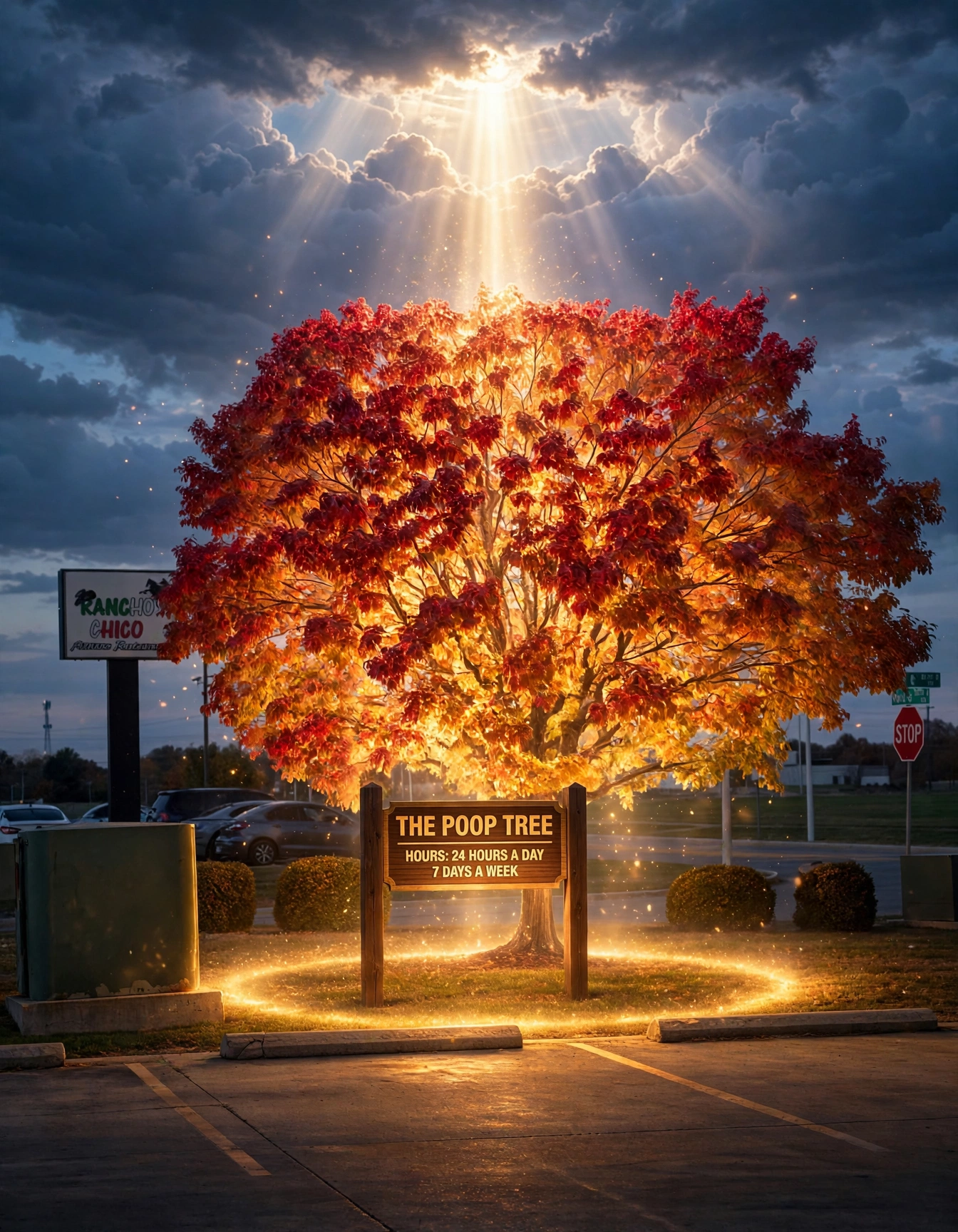
Once each year, at the height of the crimson turning, the heavens open above Springfield and the Tree is lit from within. No other day in the Pooplicist calendar — in any calendar — compares.
Pooptopia, as witnessed from the parking lot: the Beam, the Inner Light, and the Ring upon the grass. Rendered from the testimony of those who stood there and wept, then laughed, then wept again.
The Day of the Inner Light
Pooptopia has no fixed date, and this is by design — or rather, by the Tree's design. The feast falls on the single day when the canopy reaches its fullest, most impossible crimson, and only the Tree may declare it. Pooplicists therefore keep the whole of autumn in a state of reverent readiness, a practice the faith calls the Vigil of the Turning. When the day comes, it is unmistakable.
First, the clouds part — witnesses across the years describe the same geometry, a seam in the sky directly above the crown. Then the Beam descends: a single column of white-gold light, unhurried, unmistakable, striking the highest leaves. And then the thing itself, the miracle for which the day is named — the Tree begins to glow from within, each leaf lit like a coal in a hearth, until the whole canopy burns with a light that casts no shadow, and a ring of gold appears upon the grass at its base, as if the earth itself were answering.
The observances are ancient, which is to say they are exactly as old as the first Pooptopia and not one day older: the Procession of the Parking Lot, walked slowly and without irony; the Reading of the Hours, all twenty-four, aloud, to general applause; the Feast, held at Rancho Chico, whose kitchen the Pooplicists hold in an esteem second only to the Tree itself; and at the close, one full minute of silence at the base of the Sign — followed, by long custom, by the Blessing. The Tree is open.It always is.
The Sacred Calendar
PooptopiaThe Supreme Feast · Peak of the Crimson Turning
The Beam descends, the Tree is lit from within, and Pooplicism keeps its highest holy day. All other observances are, by doctrine, merely rehearsals for this one.
The Raising of the SignAnniversary of the Consecration
The posts are polished, the gold lettering read aloud, and the Eternal Schedule renewed for another year — though it has never once lapsed.
The First TurningThe First Red Leaf of Autumn
A quiet day. The first leaf to turn is located, witnessed, and pointed at by Pooplicists for some time. Then everyone goes to lunch.
The Night of the Long VigilThe Longest Night of the Year
Lanterns line the path until dawn, in honor of every pilgrim who ever needed the Tree at 3 a.m. — the Hour of the Humbled, kept all night long.
Pilgrims who cannot reach Springfield may light a candle here, and it will burn on this page for as long as they remain. The Tree accepts all flames, literal and otherwise.
The shelf awaits its first flame of your visit.
Testimonies
Witnesses to the Tree
★ ★ ★ ★ ★
"I drove past it a hundred times before I understood. Then one October morning the light hit that canopy and I had to pull over. I can't explain it. I don't try anymore."
★ ★ ★ ★ ★
"Came at 3 a.m. because the sign said I could. It was right. It is always right. That is the entire review: the sign is always right."
★ ★ ★ ★ ★
"I've seen cathedrals in Europe. Marble, gold, the works. None of them were open at 3 a.m. next to a place that serves excellent tacos. The Tree wins."
The Poop Tree stands in open ground in Springfield, Illinois, beside the Rancho Chico restaurant — whose kitchen, by ancient and happy arrangement, feeds the pilgrims the Tree receives. Look for the crimson canopy and the gold-lettered Sign. If you can read the hours, you have arrived.
No appointment is necessary. No ticket is sold. No door exists to be locked, and in all the years of the Eternal Schedule, none has been missed.
Pilgrim Etiquette
Approach at whatever hour your life requires. Speak softly or not at all. Photograph freely — the Tree has never once objected. Leave nothing but footprints and, if the spirit moves you, a small and tasteful offering at the base of the Sign. Pilgrims who wish to pray robed will find the six official outfits described on the Pilgrim Attire page.
Sacred Facts
Hours24 / 7 / 365 — Forever
AdmissionFree, as grace is free
LocationSpringfield, Illinois
LandmarkBeside Rancho Chico
Peak GloryMid-Autumn, Full Crimson
Holiest Hour3:00 A.M. — The Hour of the Humbled
Closures on RecordNone. Ever.
Dress CodeCome as you are
Is the Tree really open right now?
Yes. It is open as you read this sentence, and it will be open when you finish it. The live counter in the sanctuary above has been running since the Consecration without interruption — the Tree does not observe closing time because it has never been introduced to the concept.
Why is it called The Poop Tree?
The name is the doctrine. The Tree rose from the humblest offering imaginable and became the most glorious canopy in the county — proof, renewed every autumn, that dignity is not where you begin but what you grow into. The Sign bears the name proudly, in gold, because the Tree is not embarrassed, and neither should anyone else be.
Can I visit at 3 a.m.?
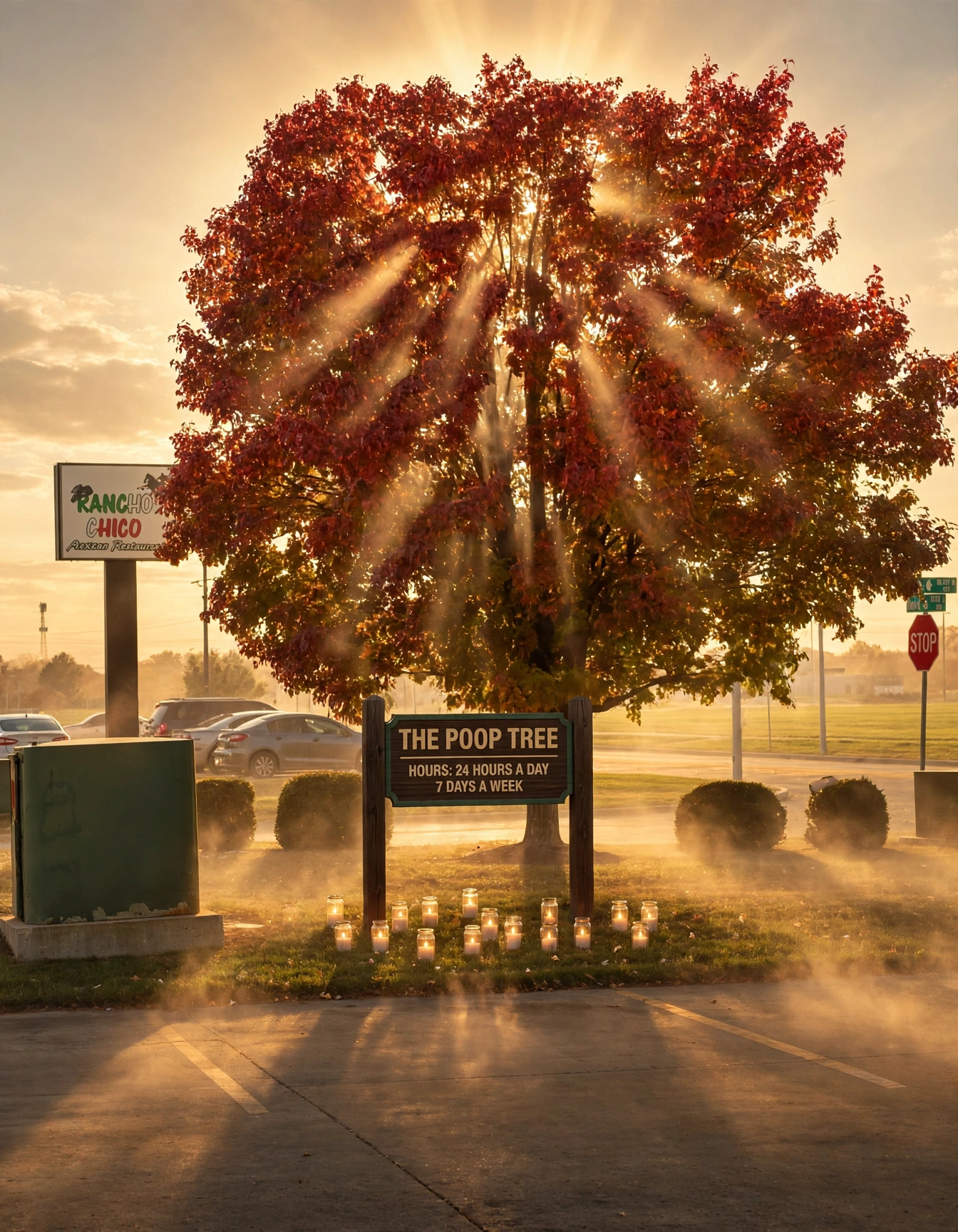
You not only can — the keepers regard the small hours as the sanctuary's finest. The Night Vigil depiction in the Visions above is a faithful rendering: moon above the canopy, lanterns along the path, and the Sign glowing its eternal hours to an audience of whoever needs it most.
Is there an admission fee or a gift shop?
There is no fee, no shop, and no collection plate. The Tree's only economy is shade freely given. Pilgrims wishing to support the pilgrimage are directed to the neighboring Rancho Chico, where the faithful have eaten well since before the Sign was raised.
What is Pooplicism — and how do I become a Pooplicist?
Pooplicism is the faith that honors The Poop Tree: no scripture but the Sign, no clergy but the keepers, no doctrine but welcome. As for becoming a Pooplicist — there is no ceremony, no form, and no fee. If you have stood beneath the canopy, or laughed at the name and then gone strangely quiet, the Recognition has likely already occurred. Welcome. The Tree is open. It always is.
When is Pooptopia?
Pooptopia, the supreme holy day of Pooplicism, falls each autumn on the day the canopy reaches its fullest crimson — the day the Beam descends and the Tree is lit from within. No calendar may fix the date; the Tree declares it, and it is unmistakable when it comes. The wise pilgrim keeps the whole season ready.
What is the Book of the Poop Tree?
The scripture of Pooplicism, gathered by the Keepers of the Sign: the Creation of the Tree, the Commandments of the Canopy, the Parables of the Parking Lot, the Blessings, and the Prophecy of Pooptopia. The Pooplicists maintain the Sign was always scripture enough — the Book simply writes it large, for pilgrims who want the whole story. Read it on its own page.
What prayer is spoken at the Tree?
The Poop Tree Prayer — the liturgy that blesses the Tree and the pilgrim together. It is spoken on arrival, on Pooptopia, and at the Hour of the Humbled, and it ends with the Amen of the faith: “The Tree is open. It always is.” You will find the full prayer on its own page.
When is the Tree at its most holy?
The theologians of the Tree are divided. The autumn party points to the full crimson canopy; the night party, to the lantern-lit vigil; the dawn party, to the Illumination. The Tree itself, characteristically, declines to choose — it is open for all of them.